

Pond Find Hope in Chaos on Terrestrials
BY SAVANNAH GALLIMORE
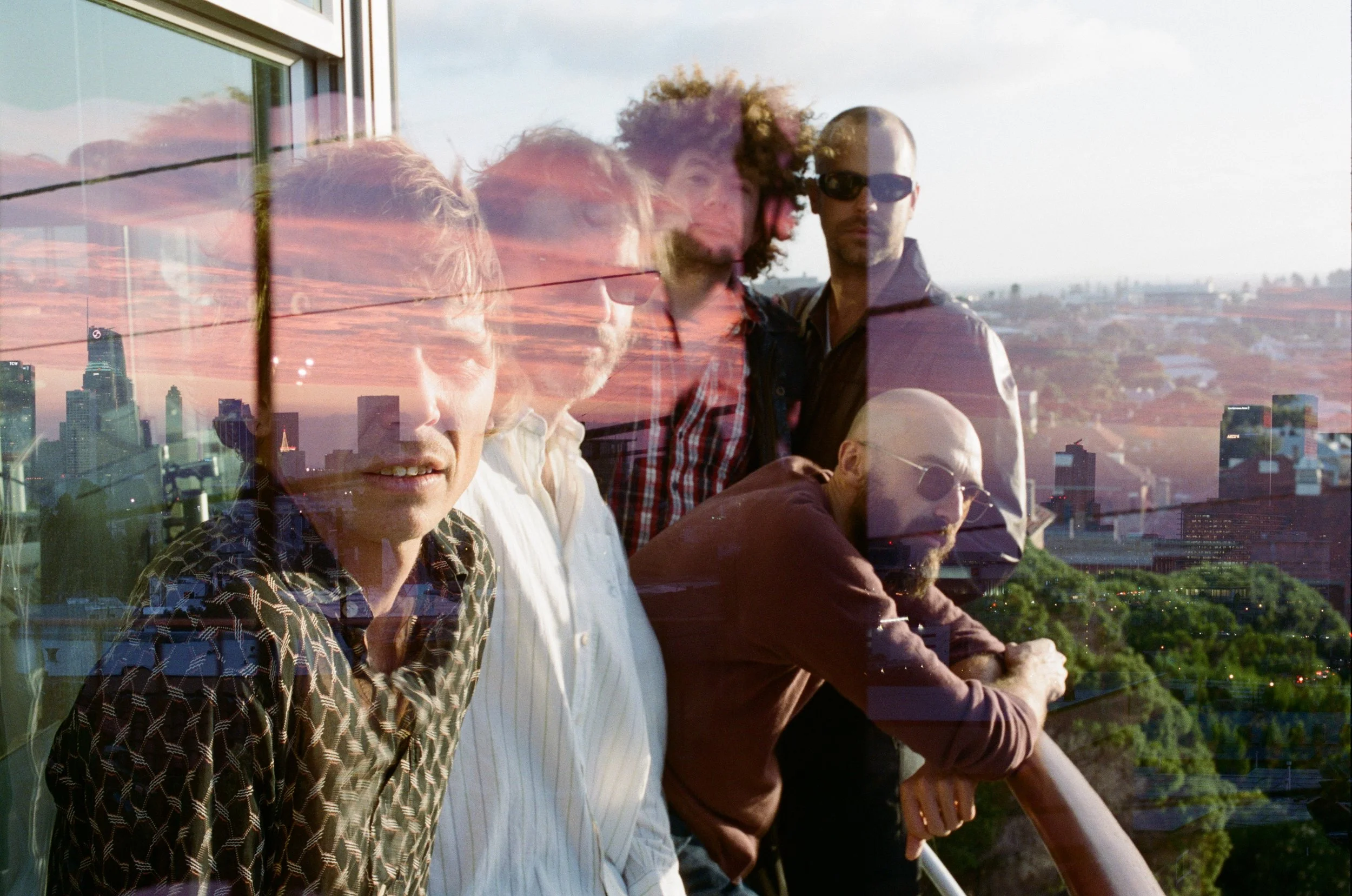
Photo credit: Sam Kristofski
Pond have spent more than a decade carving out one of Australia's most adventurous catalogues, constantly reinventing themselves. Made up of Nick Allbrook, Jay Watson, Joe Ryan, Jamie Terry and James Ireland, Pond has evolved from album to album without losing sight of their distinctly Australian identity. Their latest record, Terrestrials, the band's 11th studio album, finds them at their most focused yet, pairing driving rock'n'roll with reflections on place, community and the challenges shaping modern Australia.
Ahead of the album's release, Temper had the opportunity to chat with frontman Nick Allbrook and drummer James Ireland to talk about the making of Terrestrials, from the creative rules that shaped the record to its themes of capitalism, environmental destruction and hope. We also discussed the band's collaborative songwriting process, self-producing their music, their upcoming North American tour, and why, after 11 albums, Pond are still finding new ways to push themselves creatively.
Temper: When you look back on making this record, what stands out most about the process?
James Ireland: We had enough songs ready before we started recording. Usually, we're scrambling at the last minute, chopping songs out and trying to add new ones in. This time, it felt like all the songs were there, ready to go. We wrote them, rehearsed them, and then recorded them, whereas normally we kind of write and record at the same time and then learn how to play the songs live afterward. This time, we felt prepared.
T: I think the societal commentary of this album is very relevant to the current world we’re living in, touching on capitalism, inequality, and environmental struggles. Why did it feel important for you to make an album about these themes?
Nick Allbrook: Because seeing these things playing out makes me feel a lot, and that’s usually what inspires songwriting for me, whether it’s love or death or heartbreak or injustice or a Fremantle premiership, big feelings typically illicit bad poetry. I guess I also genuinely think we - and I mean we, as in ME - need to be reminded of this stuff regularly and if it can do a tiny thing to remind other Australians that this is still happening and that you’re not alone in feeling angry and sad, then that's a good thing… Even if it makes the album worse it's still probably a good thing. And I really believe it and want to say it. I want us to remember the gross neglect that led to Cleveland Dodd's death, and that Rio Tinto blew up Juukun Gorge, and that police stood around having a civil conversation with the terrorist who threw a shrapnel bomb into the 2025 Invasion Day rally.
T: The title Terrestrials suggests a focus on life here on Earth. What does that word mean to you in the context of this record?
NA: It reminds me that we’re all on the same planet, animals, plants, people, rich, poor. And while we don’t have to like each other, we do have to cohabit this space. It also just reminds me of extra-terrestrials, because that's usually the way we use that word, so it all ties together in a “we’re all earthlings, but we’re profoundly weird, and we’re not being threatened by aliens but ourselves” kinda way. And the actual ‘terra’ of Australia, WA, the pindan and sandstone feels like a big part of it. Home and a feeling of place that's tied to the earth that we’re also digging up and selling… It all tied together well and it's a cool word.
T: You’ve stated that you imposed some rules on yourselves while writing this album. What were those rules, and how did they help the creative process?
JI: I can't remember all of them, but some of the rules were things like no fuzz pedals and no trippy Pink Floyd chords, those major seventh, open-sounding, nice chords that we usually gravitate towards. All the drums were recorded on the same, or at least a very similar, tape machine as well. There were a few rules like that.
T: Was that mainly to push yourselves creatively and do something different?
JI: Exactly. We always try to have something that inspires the process. It doesn't necessarily have to be a musical reference; Quite often it isn't. It's usually just an idea or something we've been talking about. This time, it was those sets of rules, just to make the record sound different from the last one and the one before that.
T: You also had your own permanent studio while making this record, what was that like?
JI: We did for a while, but then we got kicked out, which was a shame. It was this room in a really nice old building that used to be an old pub or hotel in the West End of Fremantle. Whoever owned the building decided to develop it into a fancy hotel, so we had to leave.
T: Where did you go after that?
JI: We recorded some of it here, where I am now, at Tunafish Studios in O'Connor [Fremantle]. We also did some sessions over east at No Wave Studios in Byron Bay, although I wasn't there because I was having neck surgery.
I had a broken disc in my neck, so I missed that part. Our good mate Chris Wright played drums for us during that session. It happened in the middle of a tour. I had to duck out for surgery, and while I was away, they spent about a week in the studio and got the foundations of three songs down. Then we brought everything back to Perth and kept working on it.
T: This is your 11th album. Do you feel like the way you make music together has changed over time?
JI: Not really, at least not since I've been in the band, which has been since 2015. We all make little demos at home in our own studios, then bring them to the band and start the recording process together. Most of the songs are born at home before they're brought to the group, where they're fleshed out collectively. I suppose that's the part of the process that makes it sound like us.
T: You've also produced the album yourselves. Has all of your music been self-produced, or is that something new?
JI: Most of it has been self-produced. Kevin Parker from Tame Impala has helped produce some of our past projects, and he also produced one song on this new album. Other than that, we've usually done it ourselves.
T: Do you think producing yourselves is more challenging or liberating?
JI: A bit of both, I'd say. We all work as producers on other projects as well, so it's pretty natural for us. I've never really thought about what it would be like to work with someone else. Kevin's a good fit because he's a close mate. But if we brought in some big Hollywood producer from LA, I don't know. It'd probably sound nothing like a Pond record.
T: Many of these songs are populated by workers; You mention a nurse, a labour worker, a delivery driver. Was it important that the album be told from the perspective of “ordinary” people?
NA: Not particularly, not ordinary, because a lot of the characters are really weird. The ordinary characters are often placed in extraordinary circumstances, like the character in “Personal Hell” who’s partner can’t sleep because of the memory of a bushfire, or can’t find peace because they only see the home-made crucifixes on the side of the road when they go on holiday.
I did feel like I needed to mention workers in “Casuarina” though, because of the amount of incredibly smart, talented migrants who are reduced to menial work or detention instead of being engineers or surgeons or whatever.
T: I wanted to ask about your upcoming North American tour with Djo. How did that come about? Did you know each other beforehand?
JI: No, I think he's just a fan of the band, surprisingly. I think he met all of his bandmates at a Pond show in Chicago about eight or ten years ago.
He just asked us. A few of us were already going to be over there [North America] doing the Tame Impala shows. Joe asked if we could do these side shows together, and I think he thought it'd be great if Pond came along too. It'll basically be this big travelling group of mates touring around North America together.
T: What can fans expect from these shows with the new album?
JI: I think they can expect a lot of pub rock energy. We've been rehearsing the set and it feels like there aren't any slow songs anymore. We're all trying our hardest just to keep up because the songs are so fast.
Hopefully, it'll be really high energy. It's actually kind of exhausting for me playing drums. I don't feel like I've got the stamina, but hopefully there'll be heaps of energy and a really good pub rock vibe.
T: If you had to describe the album as a mood board, what would it be? Was there a colour palette, a season, a movie, or anything that inspired it visually?
JI: Kind of, yeah. We liked the idea of goths at the pub, bringing those two different subcultures together. A lot of the music reminds me of The Cure, but it also reminds me of playing pub rock gigs. We kept talking about how fun it would be to get the goths down to the pub rock shows, not literally, but just as a visual idea. It became a way of imagining those two worlds coming together.
T: The final song ends with a very straightforward declaration: "I still believe in love and work and music." What drew you to ending the record with that sentiment?
NA: Oof, I actually didn’t think about the placement of the line at the end, but it does sum up a lot of the sentiment now that you mention it. I mean, I do believe in love - like, it’d solve a lot. And I believe that it's ok to work and not reap vast riches, the work is the point sometimes, and we don’t need to look up to Twiggy Forest or Andrew Tate.
I dunno. Maybe it came from reflecting on a life spent making music that had landed me at being a landscape gardener earning $500 a week and damn proud of it.